 Lambton Family Hub
StoriesSarniaUnder the St. Clair River
The railway that went under the river
Before 1891, no railway had ever run a full-size train beneath a river. The first one to manage it went under the St. Clair at Sarnia, dug by hand from both shores at once.
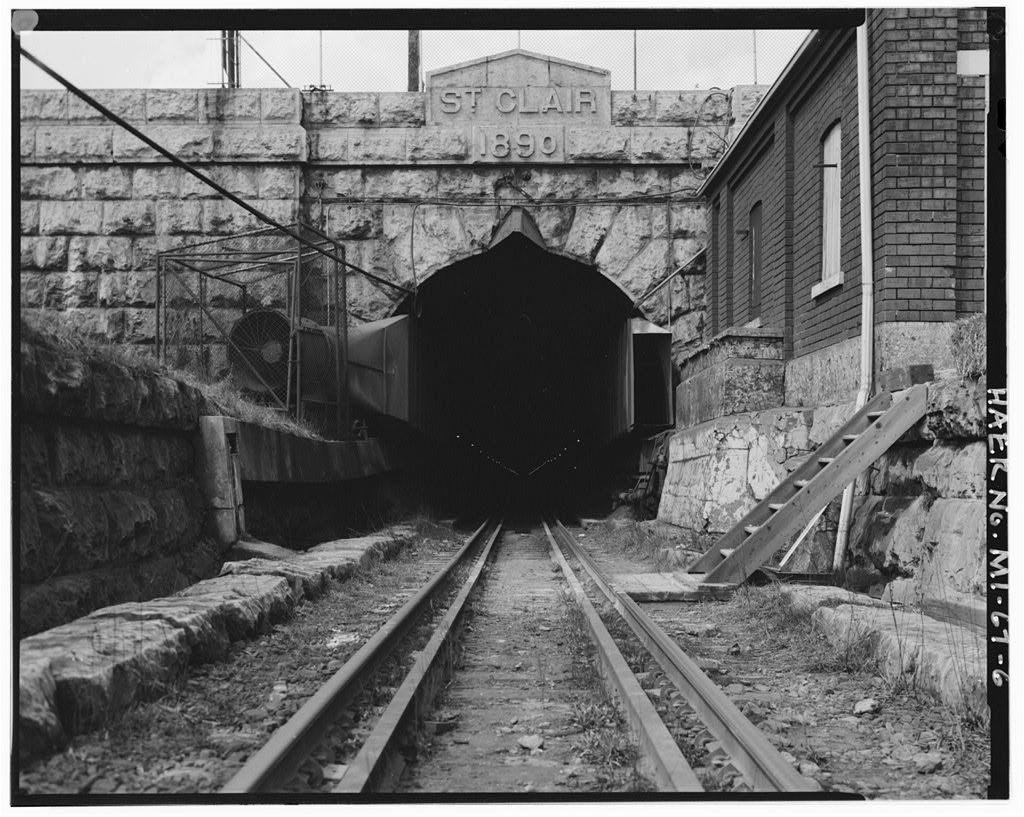
Six or seven hundred men, working in compressed air, for as little as twelve and a half cents an hour.
About this story
Trains still go under the St. Clair every day, and almost nobody watching from the shore knows the first one is down there. This is the story of how the Grand Trunk Railway dug it, what it cost the men who did the digging, why breathing inside it turned out to be the harder problem, and the one piece of it you can still stand next to with a child.
01 / Stopped at the water
Why a tunnel at all
The railway reached Sarnia in 1858, and then stopped at the water. Everything crossing to Port Huron, freight cars, passengers, mail, came off the rails and onto a ferry at Point Edward, then went back on the rails on the American side. It was slow work in good weather. The ferries fought the current, dodged Great Lakes shipping, and in winter fought the ice as well. By the 1880s the Point Edward yard had a backlog that never cleared.
A bridge was impractical. A tunnel had never been done.
The problem was the ground. Under the St. Clair is a layer of soft blue clay, and soft is exactly what you do not want to dig a tunnel through; an earlier attempt between Windsor and Detroit had already failed. Sir Henry Tyler, president of the Grand Trunk, brought in Joseph Hobson of Guelph as chief engineer, and after a run of unsuccessful tests they settled on the one method that looked like it might hold: shield tunnelling, an idea Marc Isambard Brunel had pioneered under the Thames back in 1818.
02 / Two shields, one from each shore
How they dug it
A shield is a steel shell driven slowly forward through soft ground, jacked along against the finished lining behind it. It holds the earth open just long enough for the next rings of that lining to go in. Sarnia's tunnel needed two shields, one starting from each shore, built to a design by the American engineer Alfred Ely Beach, and they were the largest in the world.
Between six and seven hundred men worked on it. Inside, the job was as plain as it sounds: dig the clay by hand, load it into carts, and let horses and mules haul it back out, while other crews bolted up the cast-iron lining behind. The whole working face was held under compressed air to stop the river pushing its way in, so every man passed through airlocks going in and coming out. Come out too fast and you got the bends.
Diggers were paid 17.5 cents an hour, the men erecting the lining 15 cents, everyone else 12.5. There was an extra dollar a day for working in the compressed air, which is how the railway priced the risk of the thing that could kill you. Three men died building it.
The two shields met beneath the middle of the river on 30 August 1890, a year after they started, a quarter of an inch out of alignment.
The finished tunnel ran 6,025 feet from portal to portal, with a bore just under twenty feet across. The river it crosses is only about 2,290 feet wide; the rest is the long slope down and back up again. It cost $2.7 million.
On 9 April 1891, steam whistles sounded on both sides of the river as engine No. 253 pulled through the finished bore, with W. Ovens driving and W. McNeish firing. The tunnel opened formally that September. For a while, Sarnia was on front pages around the world.
03 / The air inside
The part that is harder to tell
The tunnel worked. Breathing in it did not.
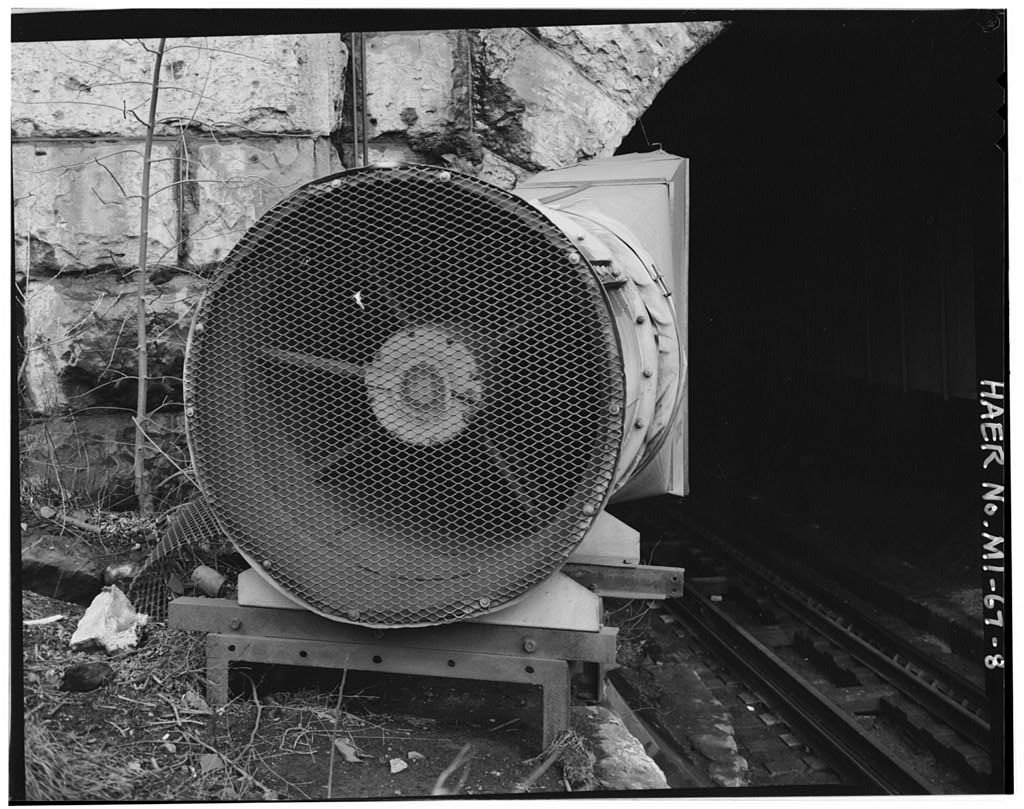
A coal fire in a sealed tube under a river produces carbon monoxide with nowhere to go. In 1892, the year after it opened, a conductor died inside when his train came uncoupled. In 1897 three more men, a conductor, an engineer and a brakeman, died when a train uncoupled about 200 feet inside the Canadian entrance and left them in the fumes. Between January 1892 and October 1904, ten men died of asphyxiation underground.
The Grand Trunk electrified the tunnel in response, running the trains through on a high-voltage wire from 1908. The gas problem ended. Electric haulage lasted until 1958, when ageing equipment and the cost of keeping it running pushed the railway over to diesel, which, in a tunnel this short, did not bring the old danger back with it.
04 / In the blue clay
A trilobite at fifty feet
In 1890, somewhere fifty feet down in that blue clay, a worker picked a fossil out of the spoil: a fragment of trilobite, an animal that had been dead for a few hundred million years before anyone thought of digging here. Somebody kept it, and somebody labelled it, and the original handwritten label is still with it: from blue clay St. Clair Tunnel 50ft depth 1890. It is in the collection of the Lambton Heritage Museum, along with the souvenir china that was sold to mark the opening.
05 / A hundred and five years
The tunnel that replaced it
By the late 1980s the trains had outgrown it. Double-stacked container cars and multi-level auto carriers were simply too tall for the bore, and you cannot make a finished tunnel wider. So CN dug a new one, thirty metres north of the old one, driven from the Canadian side to the American side by a boring machine the crews named Excalibore. It opened in 1994, and the 1891 tunnel was sealed.
There is a detail in that worth holding onto. The 1891 tunnel was built to end the ferry crossing, and it did, for anything that fitted. But freight cars kept growing after the Second World War, and the ones too big for the bore went back onto the ferries. The last of them did not stop running until 1994, when the new tunnel finally took everything. The problem the Grand Trunk set out to solve in 1889 took a hundred and five years to finish solving.
The engineering bodies of both countries named it a Civil Engineering Landmark in 1991, on its hundredth birthday. Parks Canada recognised its construction as a National Historic Event in 1992, and the United States made it a National Historic Landmark in 1993. For a hole in the ground that almost nobody thinks about, it is unusually decorated.
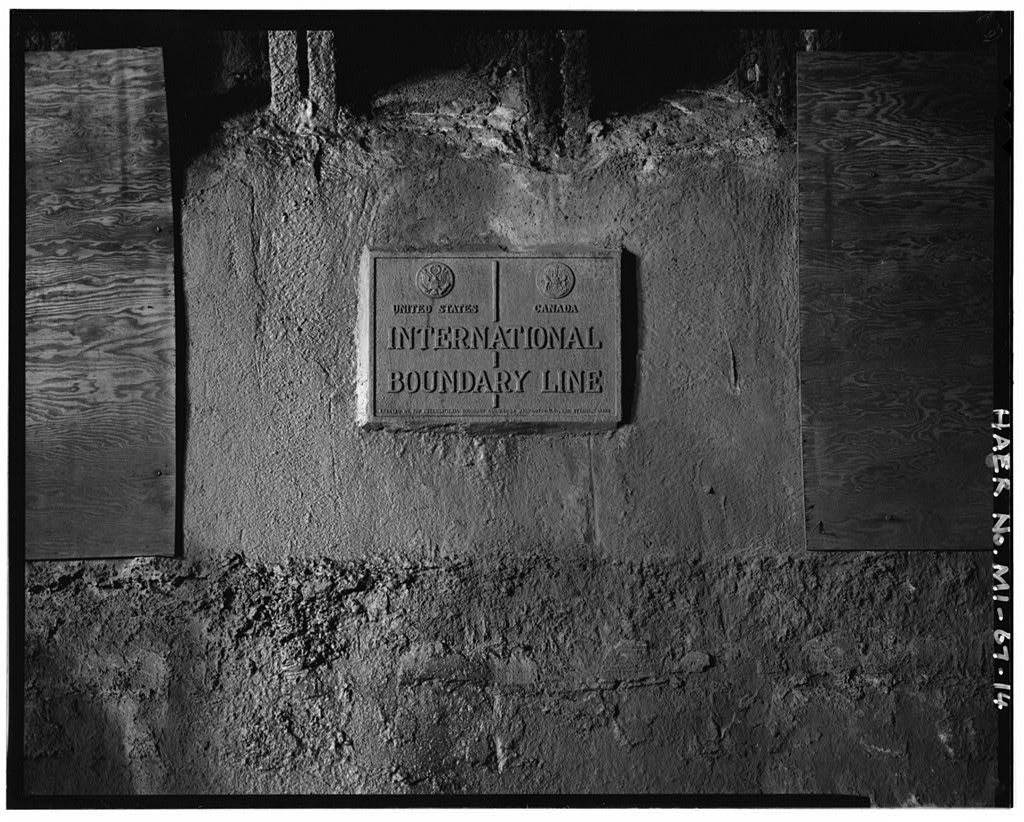
Look at a map of the Great Lakes and the reason Sarnia got it is obvious. The St. Clair is the narrow neck where the whole system pinches in, and Sarnia sits on the Canadian side of it. Everything that has ever made this a border city, the ferries, the bridge, the rail yards, the freighters people still watch from the waterfront, comes from the same geography that made a tunnel worth digging in 1889.
The dates
- 1858
- The railway reaches Sarnia. Everything crosses the river by ferry.
- 1889
- Two shields begin digging, one from each shore, under compressed air.
- 1890
- On 30 August the shields meet in the middle, a quarter inch out.
- 1891
- Engine No. 253 makes the first trip through on 9 April. The tunnel opens formally in September.
- 1892 to 1904
- Ten men die of asphyxiation from locomotive fumes.
- 1908
- Electric locomotives take over, and the air clears.
- 1958
- Diesel replaces the electrics.
- 1994
- A bigger tunnel opens alongside. The original is sealed.
06 / Five minutes, free
What you can go and see
The 1891 tunnel is sealed and its replacement is a working freight route, so there is nothing to explore and nowhere to climb. But a section of the original cast-iron lining, one of the actual rings those crews bolted together under the river, is on display in Sarnia with a plaque beside it, near Campbell Street, and there is a Parks Canada plaque at the site as well. It is free, it takes five minutes, and it is a surprisingly good thing to stand next to with a child who has just been told that men dug a railway under a river with hand tools and a horse.
The Lambton Heritage Museum holds the tunnel material itself, including the trilobite and the commemorative china. Worth checking what is on display before you drive out.
Keep reading
More stories from the water.
Sarnia
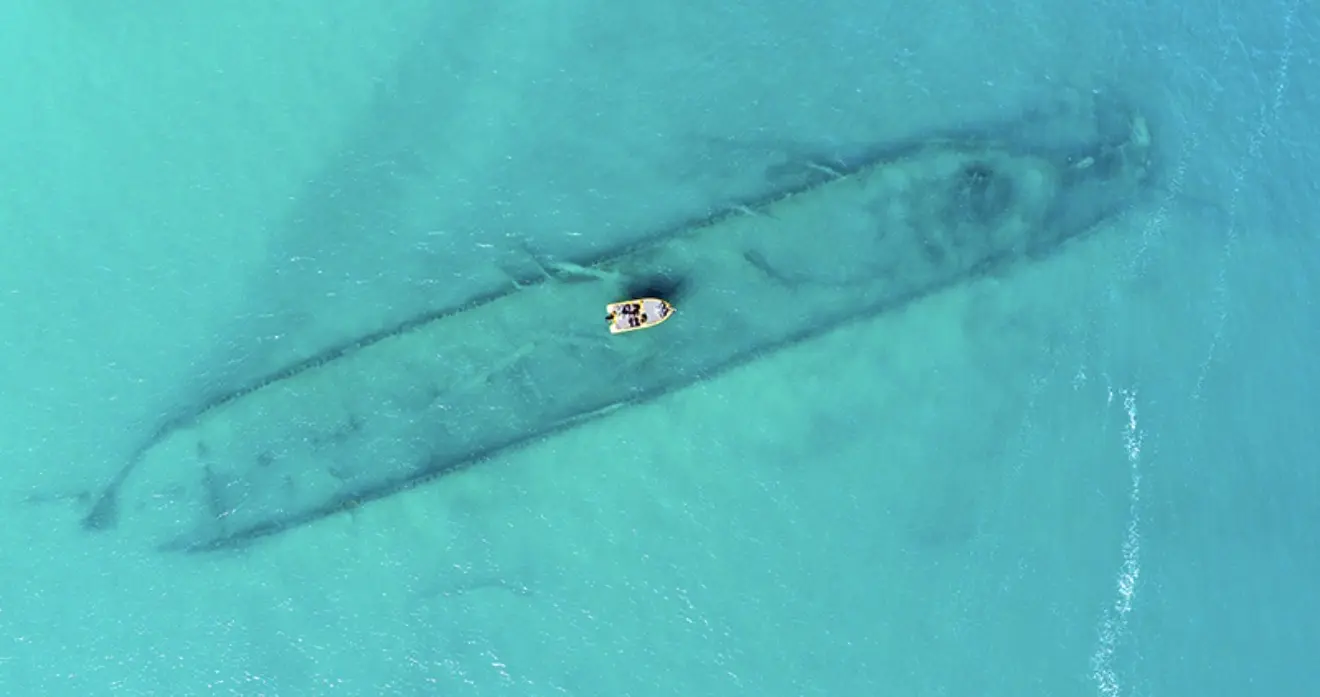
The shipwreck beneath Canatara Beach
An 1888 wooden freighter lies in shallow water just off the sand, towed there as a breakwater in 1923. It still surprises lifelong Sarnians.
St. Clair River
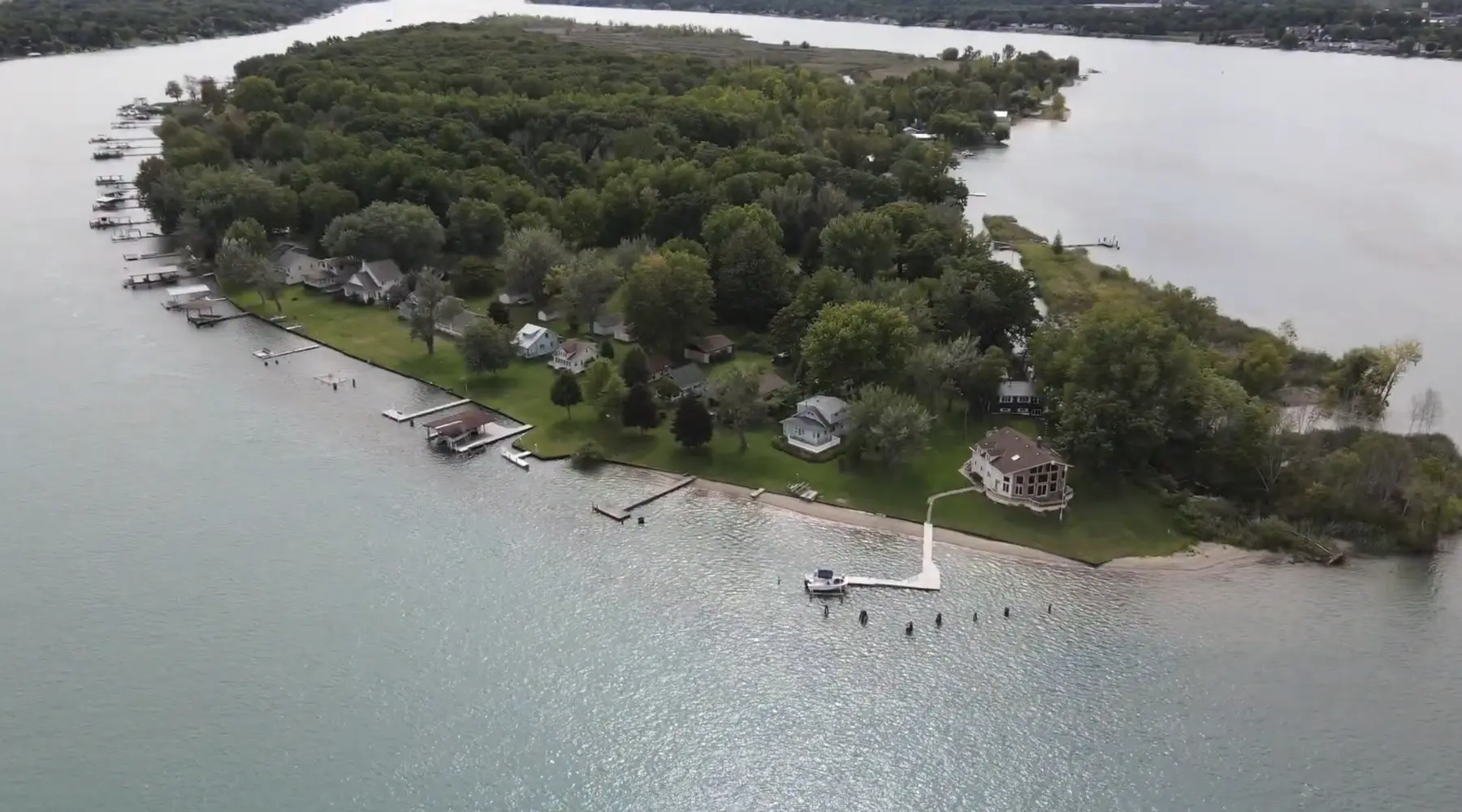
Stag Island, the forgotten resort
The quiet cottage island near Corunna was once one of the busiest summer destinations around, reached by excursion steamer and filled with hotels and dancing.
Sources: Lambton Heritage Museum, “A Tale of Two Tunnels: The St. Clair Tunnel”, which holds the tunnel collection; the Ontario provincial plaque, “The St. Clair Tunnel”; Sarnia Historical Society, “Poisonous air made St. Clair River Tunnel a deadly place to work”, for the asphyxiation figures; the American Society of Civil Engineers historic landmark record, for the wage rates and the tunnelling method; and the Parks Canada Directory of Federal Heritage Designations.
Three men died building the tunnel; the ten asphyxiation deaths came later, after it opened. The 1891 bore should not be confused with the tunnel opened alongside it in 1994. Sources differ on how the shields were driven forward, screw jacks or hydraulic rams, so this account does not say which. Suggest a correction.